
In 2019, the City of Montreal authorized the construction of its first industrial composting plant. Located in the industrial section of the Saint-Laurent borough, this facility aims to process approximately 50,000 tonnes of food waste annually.
Under the current municipal system, Montreal’s food waste is transported to processing facilities located as far as rural Ontario and Joliette. While the city’s efforts to compost are valuable, this long-distance transportation significantly increases carbon emissions. This was one of the driving factors behind the city’s decision to build a composting facility on the island and make Montreal’s composting services more environmentally sustainable and locally grounded.

The centre in Saint-Laurent processes both food and yard waste.
But efforts to address Montreal’s food waste crisis came with strong resistance. While the $175-million composting facility was ultimately approved by 35 city councillors, 21 voted against it, revealing deep divisions and underlying tensions surrounding the project. These tensions had already surfaced in 2018, when protests erupted from both residents and business owners in Saint-Laurent after they were informed about the proposed project. Concerns arose around increased traffic from composting trucks along Henri-Bourassa Boulevard and Highway 40, as well as frustration over the lack of public consultation regarding the project.
However, the biggest concern was the potential for unpleasant odors spreading into their neighborhood. This backlash persisted despite the fact that the facility would operate in a fully enclosed building equipped with negative air pressure systems designed to contain strong odors. In an interview with CBC News, one resident voiced their frustration:
“It should be 500 metres away from residents, the habitats, and from commercial [businesses]. Why choose this area? Why not choose an area closer to where it’s going to be used? Why not choose an area in the countryside?”
Despite its substantial cost and the controversy surrounding its development, the facility was completed last year and is now in operation.
I first learned about this facility in 2023 while taking a course on Environmental Assessment at Concordia University. As a compost enthusiast who lives just a five-minute drive from the composting plant, I was intrigued and decided to research it as part of my course assignment. As I read more about the extensive and expensive odor control measures the city implemented, and the protests that arose despite those efforts, it became clear to me that one of the greatest and most challenging barriers to tackling food waste is how we’ve been conditioned to perceive waste itself.
There is a deep stigma surrounding organic waste. It is seen as dirty, gross, smelly, and inconvenient to deal with. While society wants the many benefits that come with composting, like having fertilized soil, reducing landfill waste, and mitigating our climate crisis, nobody wants to do the dirty work or even live near the infrastructure that makes these positive outcomes possible. People want change, but not if it shows up in their backyard.
This dilemma is a tale as old as time in the sustainability world. While selling worms at Maison Robert-Bélanger, I was seated next to a vendor named Nicole, an artist who sells plants and flowers native to Eastern Canada. During the market, a visitor was drawn to the bright purple petals of one of Nicole’s New England asters. But when Nicole explained that this flower attracts endangered bumblebees, the visitor no longer wanted to buy it.
“I don’t want to deal with bees in my yard,” she said.
Nicole explained how native bees pollinate many of the crops we eat, but the customer moved along.
Nicole turned to me, smiled, and said: “People like to eat honey, but they don’t want to deal with the bees.”
That comment stuck with me. As I looked around at customers buying tomato and cucumber starters to grow fresh produce in their backyards, I realized that none of them bought compost needed to actually nourish those plants. Everyone likes fruits and vegetables because they look cool and taste great, but few are willing to face the uncomfortable, “messy” parts that make growth possible.
It’s ironic. Poop. The smelly, “gross” part of nature, is exactly what enriches the soil, feeds our crops, and sustains the entire food cycle. Is it ugly? For many, absolutely. But it is just as essential. In fact, the enrichment of soil marks the beginning of a circular food cycle. As Nicole’s mom later said: “Nature is not preserving the aesthetics. Sometimes, it’s the ugly that makes the beautiful.”
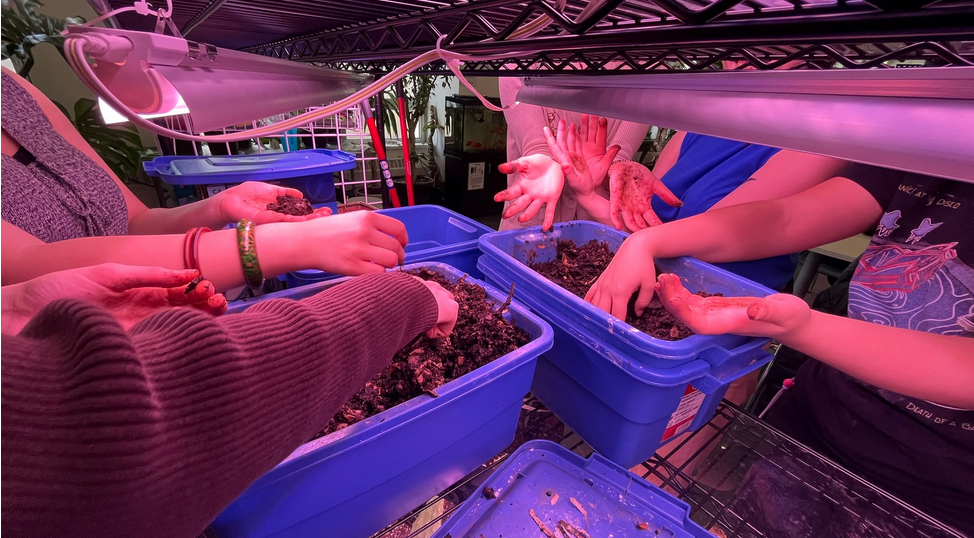
ABCompost volunteers helping us do the dirty work in combatting our food waste crisis
When it comes to environmental issues, people naturally want solutions that are convenient and easy. In the case of food waste, people want city pickup services and the simple routine of tossing scraps into a bin to forget about them. And while I agree that composting must be accessible and simple, there is a fine line between convenience and avoidance.
Composting bins, along with our municipal composting system, have done a great job at reducing Montreal’s food waste and putting us a step in the right direction. But, the uncomfortable truth is that composting bins have also made us detached from the true scale of the food waste we generate and the impact our food systems have on the planet. By containing scraps in bins that look very similar to garbage bins, they give the illusion that food waste is out of sight and is just another form of “garbage”. It also paints the picture that our food waste crisis can be ignored. Therefore, when we try to improve these solutions and make them more effective, people hesitate. The smelly and “ugly” reality that many blind themselves to turn them away. But ignoring a problem doesn’t make it disappear.
Big problems require big cultural shifts that sometimes make us uncomfortable. And this is part of the reason I enjoy vermicomposting. I feel that I am challenging a system that does not want to be challenged. I am taking part in a slow cultural shift that is gradually catching on. Embracing the uncomfortable parts of nature just as much as the beautiful parts will be essential if we want real change and if we truly want to tackle the climate crisis we are facing.
After all, if we want to have honey, we have to accept the bees.
Written by Catherine Rokakis of ABCompost
 Concordia Greenhouse Project